
Main Street paving could come in late summer
By Ian MacKay
Main Street could get a new surface as far north as Sixth Avenue later this summer, with Southwest Paving of Swift Current submitting the low bid of about $416,600 to mill and recap the first four blocks.
Southwest was one of two companies to submit a bid before the deadline. A second bid of about $460,000 arrived approximately a week late, public works superintendent Bob Bors told council at the June 1 meeting.
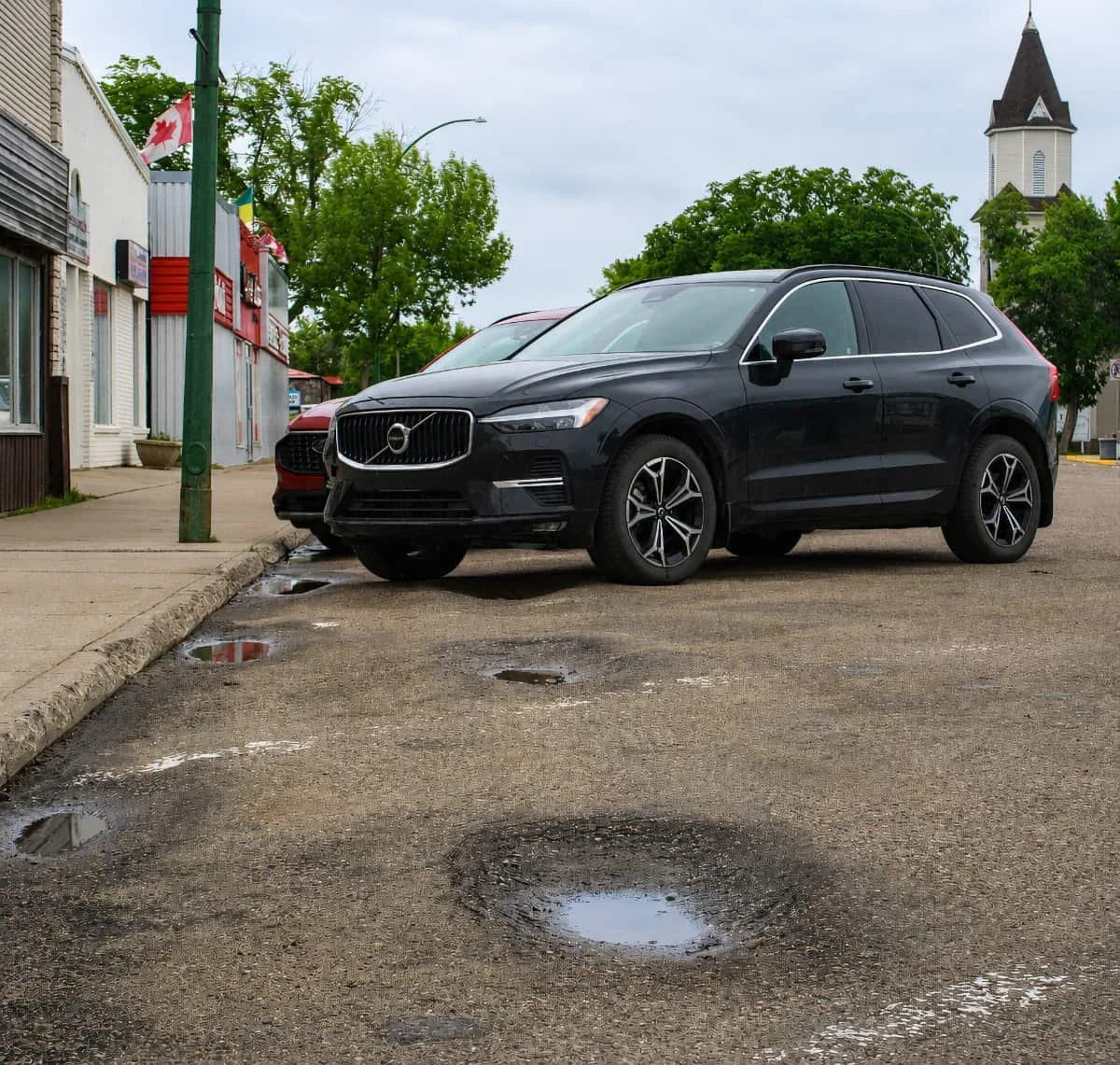
Pothole problems. Water pools in a series of potholes along Main Street following a Thursday morning shower, as a vehicle navigates the deteriorating pavement in front of the post office. PHOTO BY IAN MACKAY
Bors said he has been pushing Southwest to schedule the work later in the summer to avoid heat-related damage.
"If we allow traffic on a freshly paved surface when it's too hot, especially in front of the post office, when vehicles aren't moving and they crank their tires, they will create potholes," he said.
If temperatures hit 35 degrees on a freshly paved surface, Bors said the street would need to be closed for a few days before reopening to traffic. He acknowledged that would create hardship for nearby businesses.
Southwest also bid about $196,000 to resurface the stretch from Fourth to Sixth avenues. Both bids use a mill-and-recap approach covering the full width of Main Street, which council preferred to avoid raising the crown.
A competing bid proposed milling only the gutters and overlaying the centre to raise the crown, at about $56,000 less. Bors described the Southwest process as milling down, then applying a levelling course, followed by two and a half inches of pavement.
The process does not improve drainage, Bors noted, partly in response to a request from Coun. John Kadler for mill-and-recap proposals on nearby avenues. Past councils have prioritized getting water off those streets.
"Regardless of how old your pavement is, if you get water underneath it, you end up with failures," Bors said.
Done at the right time, mill-and-recap should result in pavement lasting 20 years, he said. Main Street last received an overlay in the mid-1990s.
Most local streets were first paved in the 1970s using a clay stabilization process. No further paving occurred until the 2000s, leaving many streets now 45 to 50 years old on driving surfaces with a 20-year life expectancy.
Bors suggested George Street, which he estimated was last worked on in 2004, as a candidate for mill-and-recap.
Engineering contractor Aecom has prepared a priority list of blocks assessed by Bors and one of its engineers, with rough cost estimates made without core samples. The estimates date from around the mid-2010s.
New chief administrator Damon Werrell, attending his first council meeting, said he had reviewed the list but wanted to confirm that Aecom staff still agree with its priorities. He said he would bring a proposal to a future council meeting after consulting with Bors.