
Seniors learn how to prevent falls at age-friendly Rosetown event
By Ian MacKay
People, especially seniors, can fall down for countless reasons, people learned during the safety event that Age Friendly Rosetown presented on Oct. 22.
A fall she suffered “happened on ice that was covered by snow and there was nothing that you could do” to stop herself from falling, local occupational therapist Krista Martens told an audience at the seniors centre. Had she been more aware, “maybe I could have avoided that spot,” Martens said.
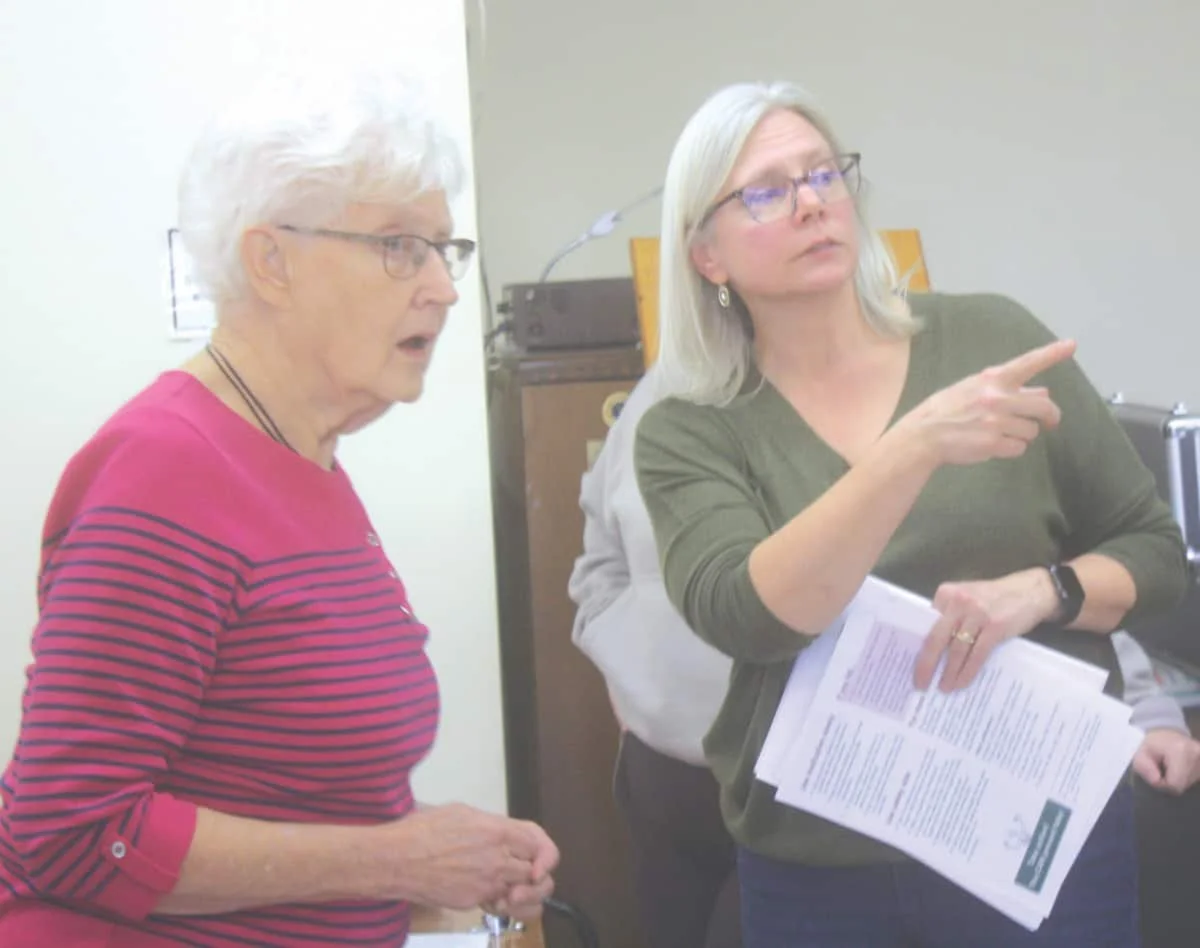
Occupational therapist Krista Martens (R) directs Norma Lewis to some information after Martens gave a presentation on preventing falls during the Age Friendly Rosetown safety event at the seniors centre on Oct. 22. Photo by Ian MacKay
Falls had caused 85 per cent of hospitalizations for older Canadians, according to a study published in 2015. It focused on data from Saskatchewan, where falls led to 77 per cent “of all injury hospitalizations,” a summary of the study said.
Women, people of “advanced age” and from “certain geographical areas” had higher hospitalization rates and “about one-third” of seniors who went to hospital because of a fall “end up in long-term care,” the study said.
“We know that, for the most part, falls are predictable and preventable,” Martens said, adapting a quote that from Safe Saskatchewan.
Risk factors include personal or health conditions, impulsive behaviour, the equipment we use and environmental factors, such as “our town, our yard,” she said.
“When we get a bit older, our bodies don’t work the same,” Martens said. “We need to work hard on our balance and our strength.”
The interaction created by taking four or more medications “might be an issue that might automatically increase our risk of falling,” along with sensory changes, such as vision, hearing and reflexes, to how one feels on a particular say, she said.
“If we’re feeling down, depressed or blue, we’re maybe not as aware of what’s going on around us,” Martens said.
Pets, floor mats, poor lighting, grandchildren’s toys laying around and climbing a ladder also represent risk factors, along with smoking and “other things we know aren’t good for our health,” she said. Other causes can include being in a hurry, not paying attention and not being active.
“The less active we are, the more it impacts our balance and our strength,” Martens explained.
People should also wear footwear with flat bottoms, make sure a room they’re walking in has good lighting and use handrails when going up or down stairs. Also, people shouldn’t be afraid to ask for help, participants agreed.
Martens distributed information such as a home safety check list and said that health staff including herself could conduct “a fall risk assessment” for people.
Physiotherapy is more well known than occupational therapy “but we have a wide variety of things that we can address with people,” she said, noting that October was Occupational Therapy Month in the province.
Occupational health covers everything people do daily “that gives our lives purpose,” to take care of ourselves and that we want to do, Martens said.