
Residents force rethink of local street projects
By Ian MacKay
Residents sent town staff and engineers back to the drawing board after petitioning out both local improvement projects that engineers had planned.
Seventy per cent of owners on Little Flower Avenue, representing 65 per cent of the properties’ assessed value, and 53 per cent of owners on Fortune Crescent, covering 56 per cent of the assessed value, signed valid petitions opposing the projects by the Nov. 27 deadline.
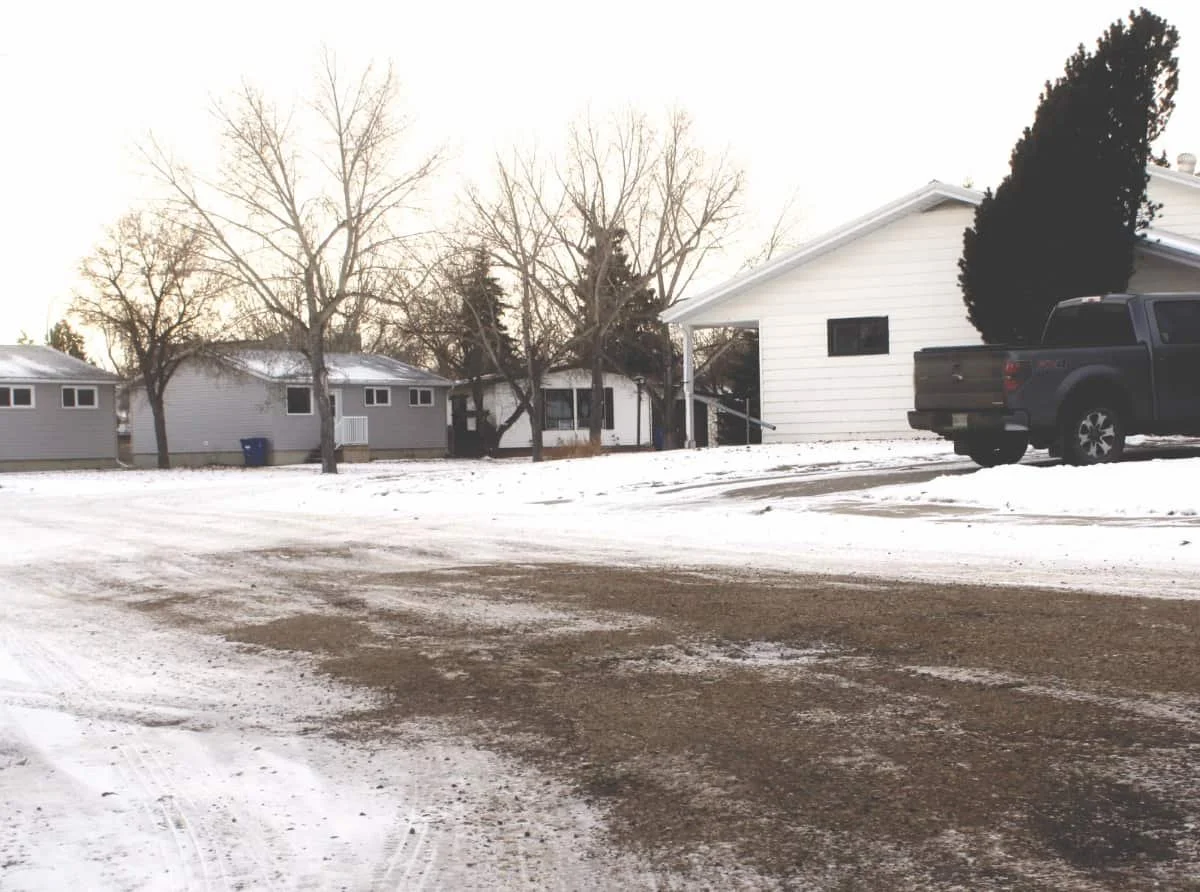
The recent skiff of snow hides many of the imperfections along Fortune Crescent near its eastern intersection with Ninth Avenue East. Ten of the street’s property owners signed a petition against rebuilding it, forcing town council to give up its plan to have the work completed during 2026. Photo by Ian MacKay
The petitions mean the projects won’t “proceed as originally planned,” Mayor Trevor Hay said during the Dec. 1 council meeting. Their decision “reflects the voices of many who felt strongly about the direction of these projects,” Hay said.
He called the petitions “a sign of a healthy democracy. It shows that people care deeply about their neighbourhoods, their streets and their shared spaces. I respect that passion and want to assure you that your input matters,” he said.
“Although these specific projects are paused, our commitment to progress remains unwavering. We will take the opportunity to revisit our plans, listen more closely and explore alternatives that better align with the priorities of our residents.”
The high cost of the concrete to provide better drainage was considered a major factor in the residents’ decisions.
“On Little Flower alone, it was $250,000 just on concrete,” said Amanda Bors, the town’s acting chief administrator. Removing that would have cut the cost considerably, but council aims to “focus on drainage to save our streets,” Bors said.
Engineers had planned rolled curbs and gutters made of concrete to eliminate a gap between curb and asphalt that allows water to get underneath the pavement and cause it to break up through freeze-and-thaw cycles.
Meetings with residents showed that costs were a major concern, councillor Kimiko Otterspoor said, suggesting finding a different, cheaper way to finance pavement work.
Councillors had prioritized rebuilding streets in the worst condition, but “they’re very costly,” Hay said. He suggested switching to streets in the downtown core, saying, “Maybe they don’t need as much work.” He later suggested surveying residents to see which projects draw a more favourable response.
Residents will want to know the costs from the start, said Bob Bors, the public works superintendent.
Officials have gotten to know the expenses for the respective forms of street rehabilitation, Hay said.
The engineering process considers many things, including whether curbs can be fixed and improving drainage, Bob Bors said.
“Unfortunately, every year, stuff gets more expensive,” he said. In the past, people complained about poor drainage, which the rolled curb and gutter is designed to alleviate, “but then the costs go up,” he said.
“We can go back to the old way of doing it,” and water will stay on streets instead of flowing off. That reduces the “life of the street and no one likes living with a lake in front of their house,” Bors said.
Without the curb-and-gutter system, where the two elements join at a spot higher than the water flows, water passes through a space between the flat curb and the asphalt, getting under the pavement and damaging it faster, he explained.
“We don’t want to have a puddly neighbourhood where your streets are constantly deteriorating because we don’t have proper drainage,” Otterspoor said later. “You can’t pave something, not fix the drainage and have that road last. It’s just not possible.”
There appeared to be “a lot of confusion” due to all the options that Little Flower residents saw, Amanda Bors said.
Councillor Greg Carlson suggested altering the cost share to 40 per cent for owners and 60 per cent for the town.
Bob Bors said the town could cover the drainage expense, with property owners paying for the pavement. Engineers could build to a lower standard, but that would affect its certification, which provincial authorities consider, he also said.