
RCMP and military service remembered at Rosetown Civic Centre
By Ian MacKay
People heard about RCMP officers who died at the hands of gunmen, plus Canadian wartime details, during the Remembrance Day ceremony in Rosetown.
The RCMP are also part of the Canadian armed forces, said Jeanette Abbott, who gave the feature address during the event at the civic centre on Nov. 11.
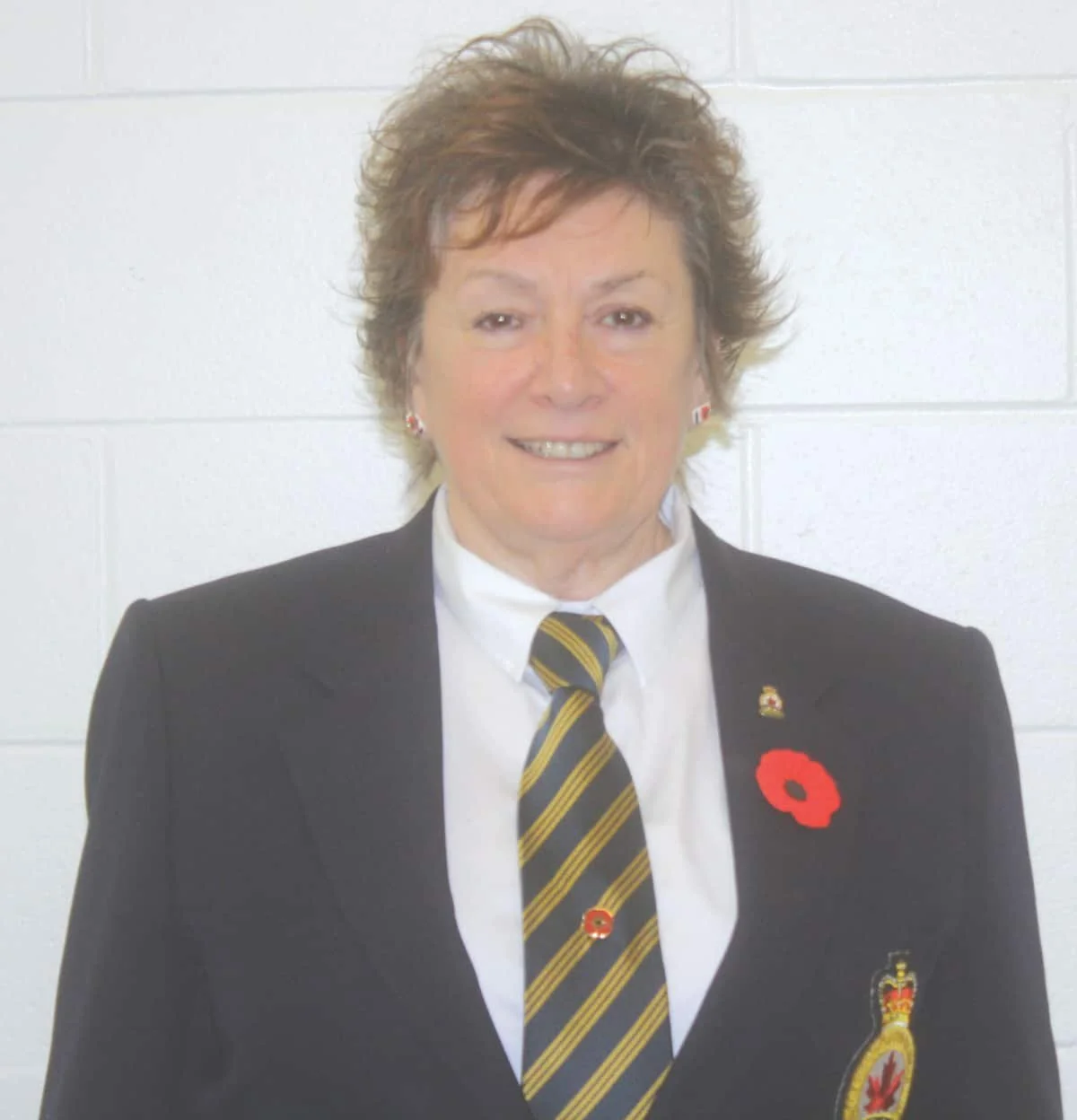
Jeanette Abbott.
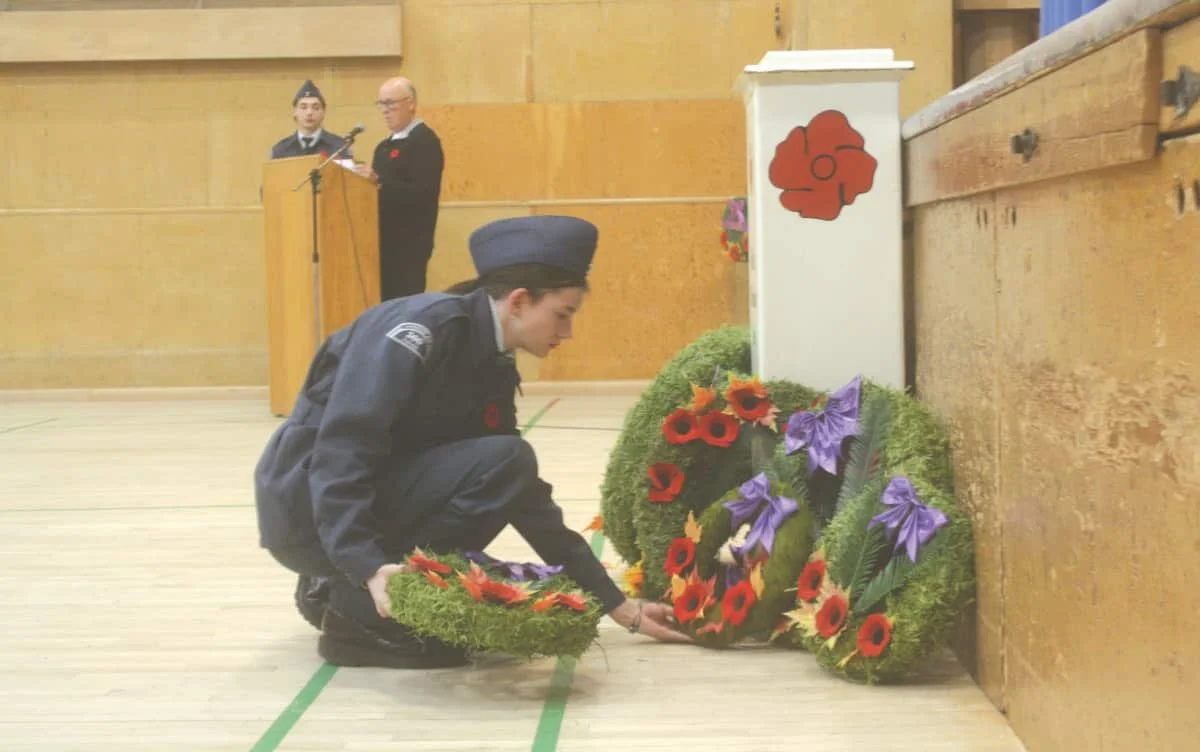
Ella Shipman, with the 300 Fisher air cadet squadron in Biggar, lays a wreath for someone who lost family members in the armed forces during the Remembrance Day ceremony at the Rosetown Civic Centre as Coltyn Martinson waits his turn with Kevin Gawletz, who officiated the wreath laying. Photo by Ian MacKay

Legion members Ken Cyrenne (L) and Katrina Anderson remove the Saskatchewan and Legion flags from stands before leading Legion members and other dignitaries out of the civic centre auditorium at the end of the Remembrance Day ceremonies on Nov. 11. Photo by Ian MacKay
A total of 234 North West and Royal Canadian Mounted Police officers died, including 78 “shot and killed while on duty” between 1920 and 2014, said Abbott, a member of the local Royal Canadian Legion. Others died in such things as vehicle accidents and natural disasters.
The murdered RCMP officers included constables Robin Cameron and Marc Bourdages, killed “on a dirt road” near Mildred, west of Spiritwood, on July 7, 2006, while responding to a domestic incident, and four others “ambushed” in March 2005 when they entered a farm building near Mayerthorpe, Alta., she noted.
Katherine Tucker, who served as master of ceremonies, said she knew some RCMP officers who died and had even encouraged one to join the force, “so I live with a little regret over that, because he lost his life so young.”
Trips to European battlefields organized by Kevin Gawletz, who also took part in the ceremony, allow people to stand “in front of a Canadian gravesite or a memorial where you see a person’s actual name (that) causes you to stop, even for a brief moment, and think about that person,” Abbott said.
“They were someone’s heart, spouse, parent, neighbour, co-worker . . . they had a life here and they had experiences and they had dreams,” she said.
People should continue to think about those who “sacrificed so much for us,” as well as anyone currently serving, she urged those attending the ceremony.
Over 620,000 Canadians went to Europe during the First World War, where our dead totalled “a staggering 66,665,” more than the number killed in all the other wars Canada took part in, she said.
“Soldiers from all armies literally had to dig in along more than 700 kilometres of trenches along the Western Front . . . to escape the murderous effects of the artillery and machine-gun fire,” she said.
“In about one hour, 710 of about 800 soldiers with the Royal Newfoundland Regiment were mowed down by enemy machine-gun fire at the Battle of the Somme” on July 1, 1916, she said.
Abbott’s great-uncle, William Morgan, was among those killed there. Morgan was aged 16 and had enlisted at 14 while “lying about his age,” she said. “It just drives home the deadly impact that war has had.”
“The cost was high” when Canadians fought at Vimy Ridge in April 1917, with 6,598 Canadians dead and another 7,000 wounded, she said.
The most recent war, in Afghanistan, was the longest war involving Canadians, lasting from 2001–2014, and the first where the bodies of all 158 Canadians who died there were brought home, she said.
Their caskets travelled the “Highway of Heroes” from Trenton Air Force Base to Toronto. One of them was Capt. Nicola Goddard, “the first Canadian female soldier ever killed in combat,” Abbott said.
Canadian women served in the front lines for the first time in the First Gulf War against Iraq, where “fortunately, no Canadians were killed,” Abbott said.
In Korea in the early 1950s, 516 Canadians fighting with the United Nations contingent were killed and over 1,000 were wounded in “Canada’s third deadliest war,” she said. About 375 of the Canadian dead are among some 2,300 UN soldiers buried at a memorial cemetery in Busan, South Korea.
About 1.1 million Canadians went overseas during the Second World War, with over 45,000 killed in action, more than 10,000 with Bomber Command.
During the Dieppe raid on Aug. 19, 1942, 916 Canadians died and over 1,946 were taken prisoner in this nation’s worst day for casualties, Abbott said.
The Atlantic Wall, Germany’s defence line, stretched nearly 2,700 kilometres and included over 8,000 concrete structures, many still standing, from Norway to Spain, she said.
Authorities know the burial places of only five of the 267 Canadians who died in the South African or Boer War. They were among 7,300 Canadian volunteers.
Another 180 died in Canada’s peacekeeping efforts “that don’t come without risks,” said Abbott, who also praised high-school teachers who began instructing classes in wartime and military history after noticing their absence.